👤 By Aqsa Ahsan
Risk Management
Stop Moving Your Stop Loss The $1,000 Mistake
Stop Moving Your Stop Loss The $1,000 Mistake
Almost every trader has lived through this sequence:
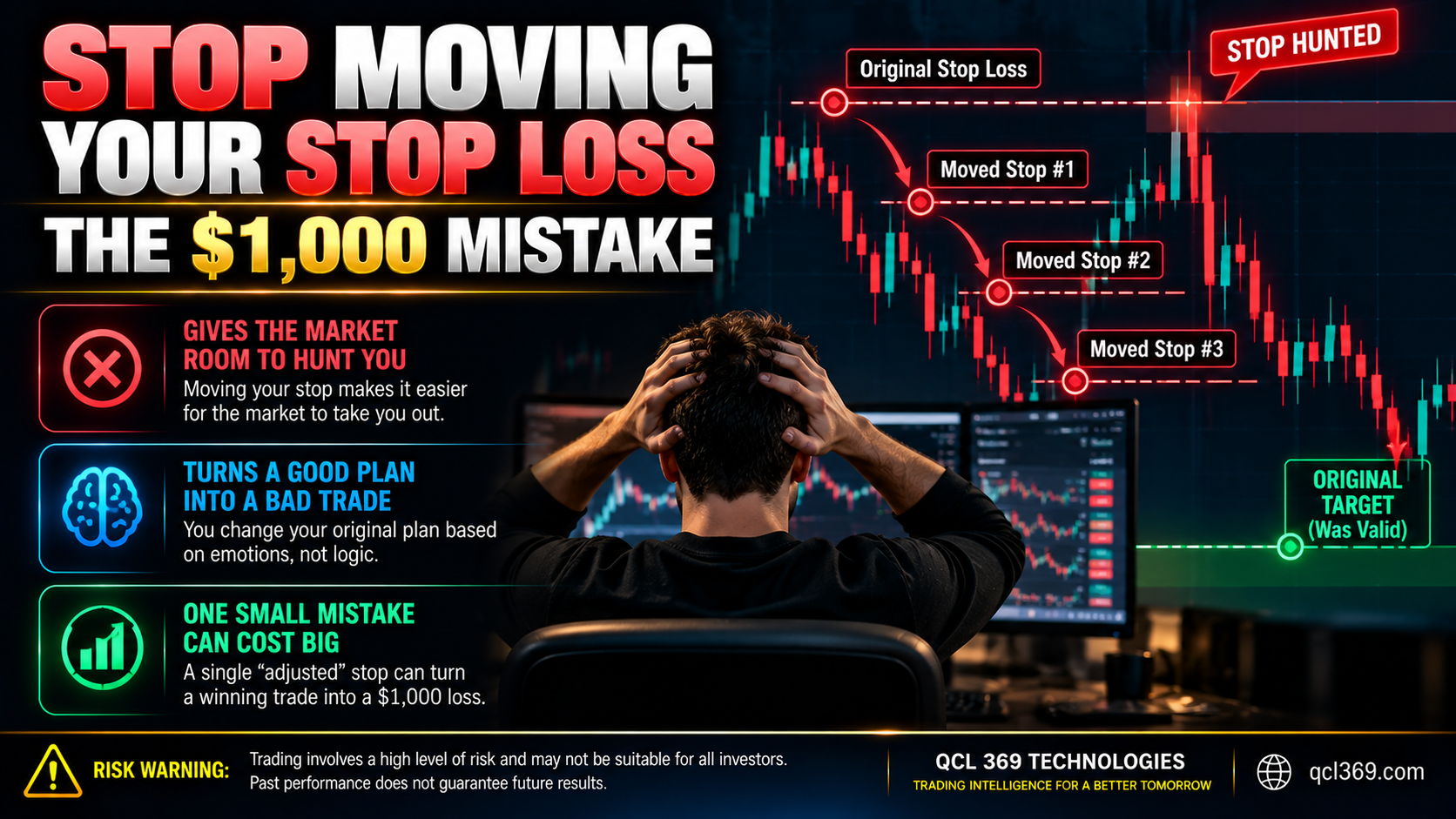
You find an entry, set your key level, calculate your position size and place a Stop Loss to limit your risk to exactly $250. The trade starts. Soon the market moves against you. As the price gets closer to your Stop Loss you feel anxious. You tell yourself it’s just taking out liquidity. If I give it 15 more points it might bounce.
You drag the Stop Loss further down.
Five minutes later the price breaks below your original level and keeps falling. You move your Stop Loss again. By the time you accept the reality your planned $250 loss has turned into a $1,000 loss.
Moving your Stop Loss further away when the market goes against you is one of the worst trading habits. It turns a planned risk into emotional gambling.
The Anatomy of the “$1,000 Mistake”
Moving a Stop Loss is usually not a technical decision it is a loss of emotional control. It follows a predictable pattern:
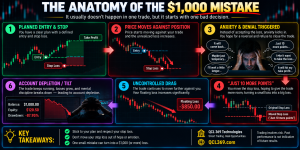
1. Refusal to Accept Invalidation
A Stop Loss is not just a random line on the screen. It marks the price where your trade idea is proven wrong. It shows the exact point where your trade setup no longer makes sense.
When you move your Stop Loss further away you are no longer following your strategy you are fighting the market. The market doesn’t know your account balance, care about your entry price or have to reverse in your favor.
2. The Asymmetry of Hope
When a trade is making money undisciplined traders often close it early because they fear losing their profit. But when a trade is losing money they become very patient holding on and hoping the market will turn around even as losses grow.
This bad habit goes against a key trading rule cut losses early and let profits grow.
3. Compounding Capital Destruction
Moving your Stop Loss doesn’t just hurt you on one bad day. As losses grow recovering becomes much harder mathematically:
| Account Drawdown | Loss Amount (on $10,000) | Gain Required to Break Even |
| 5% | -$500 | 5.3% |
| 10% | -$1,000 | 11.1% |
| 25% | -$2,500 | 33.3% |
| 50% | -$5,000 | 100.0% |
One bad trade that turns a planned 2.5% loss into a 10% or 25% loss can set your growth back by weeks or even months.
Why Moving Your Stop Destroys Risk to Reward
Trading is all about probabilities. You don’t need to win 80% of your trades to make a profit. Even a 45% to 50% win rate can be profitable if your Risk to Reward (R:R) ratio is 1:2 or 1:3 and you follow your strategy over many trades.
Moving your stop shatters this mathematical edge:
-
Planned Trade: Risk $250 to make $500 (1:2 R:R).
-
Altered Trade: You move the stop to -$1,000 but take profit at the original $500 target.
-
The Reality: You just executed a 1:0.5 R:R trade.
If you risk $1,000 to make $500 you need to win at least 67% of your trades just to break even. One Stop Loss moved further away can wipe out the profits from two or three normal winning trades.
The One Exception When Moving a Stop Loss Is Allowed
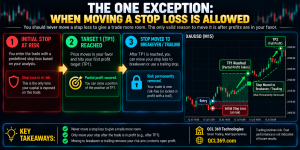
There is only one time you should adjust your Stop Loss when you move it in the direction of your trade to reduce risk or secure profits.
-
Breakeven Migration: Once the price shows clear confirmation (such as a 1:1 move or reaching Take Profit 1) move your Stop Loss to your entry price. This removes the risk of losing money on the trade.
-
Structural Trailing: Moving your Stop Loss behind new higher lows in an uptrend or lower highs in a downtrend helps protect your earned profits.
The Golden Rule: A Stop Loss may only ever tighten it must never expand.
How to Lock in Execution Discipline
1. Step Away Immediately After Execution
Once you set your Entry Stop Loss and Take Profit step away from the screen. Don’t watch every small price move or keep changing your Stop Loss. Let the trade run as planned.
2. Size Down Until the Dollar Amount Leaves You Unfazed
If watching the price move toward your Stop Loss makes you nervous or scared your trade size is too big. If risking $1,000 is too much for your account reduce your risk to 1% ($100 on a $10,000 account). When a loss is small and easy to handle you won’t feel the need to change your Stop Loss.
3. Treat the Stop Loss as an Operating Expense
In any business costs like rent, bills and delivery are part of making money. In trading a Stop Loss is simply a business cost. Taking a planned loss means you followed your trading strategy correctly.
Professional Trader Checklist
-
Define Invalidation First: First find where the trade is no longer valid before calculating its potential.
-
Use Dynamic Position Sizing: Set your lot size based on your stop loss not the other way around.
-
Hands Off the Mouse: Once your trade is active never move your Stop Loss.
-
Accept the Outcome: If your Stop Loss hits accept the loss record it and save your capital for the next good trade.
Related Readings
1- 10 Things to Avoid During High Impact FOMC Releases
2- Why Your Stop Loss Gets Hunted Every Time (And How to Fix It)
3- Top 10 Trading Habits That Make You a Disciplined Trader
To get more information visit these.
1. Investopedia
Investopedia – Financial Education
2. CME Group
3. Investor.gov
Tags: Bitcoin Trading Crypto Trading day trading discipline Forex Risk Management Forex Scalping Forex Trading Gold Trading Strategy Max Daily Drawdown MetaTrader 5 Moving Stop Loss Position Sizing Prop Firm Risk Rules Revenge Trading Risk Management Smart Money Concepts stop loss strategy Trading Capital Protection Trading Mistakes trading psychology XAUUSD Trading