Why Grid and Martingale Strategies Fail Prop Firm Challenges?
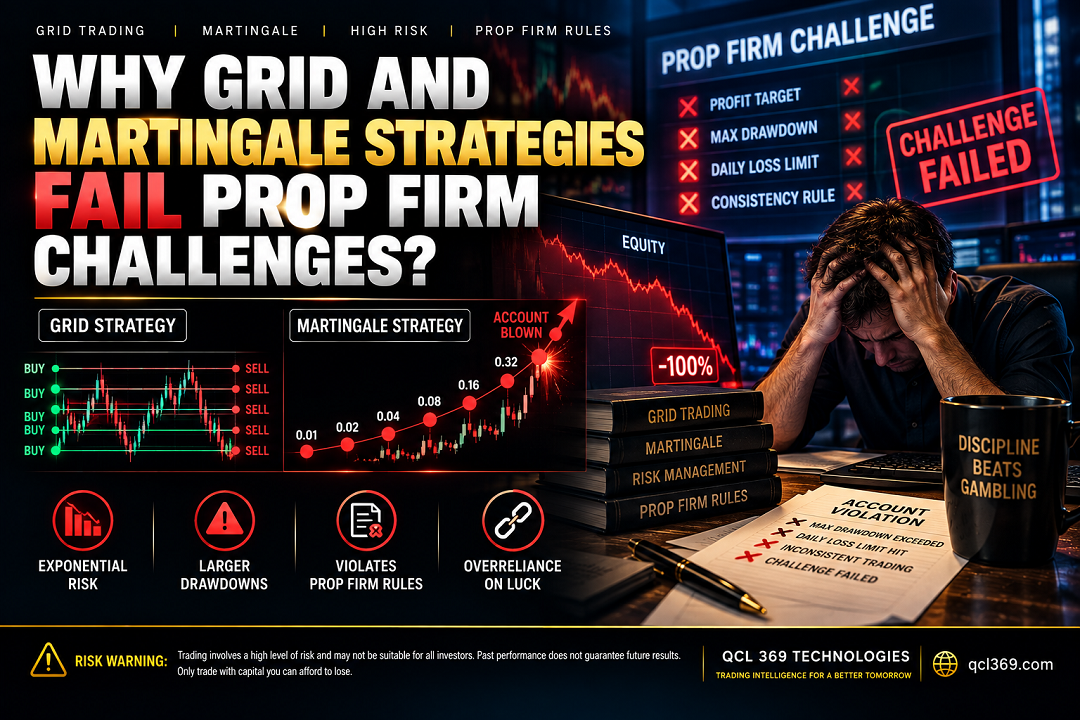
Why Grid & Martingale Strategies Fail
Prop firms give traders access to funded accounts but with strict trading rules. The two main rules are the daily drawdown limit 4–5% and the maximum drawdown limit 8–10% .
Many traders use automated bots to pass prop firm challenges. However grid and martingale bots often fail and can quickly breach the account.
Understanding why these strategies fail and how careful mathematical trading protects your capital is important for anyone trying to get funded.
Why Doubling Down Causes Account Liquidation
Why Martingale and Grid Systems Fail
A martingale system doubles the trade size after each loss, hoping one win will cover all the losses and make a small profit. A grid system places trades at fixed price levels hoping the market will eventually reverse.
These systems may work well in sideways markets but they have serious risks that can cause major problems in prop firm challenges:
-
Exponential Loss Acceleration: Doubling position sizes (e.g., 0.01 → 0.02 → 0.04 → 0.08 → 0.16) means that just four or five consecutive adverse moves create massive floating losses (drawdown).
-
Extended Trends Destroy Unhedged Grids: Markets can move strongly in one direction for hundreds of pips without a major pullback. In a strong trend a grid keeps adding losing trades against the market direction.
-
No Hard Stop Losses: Grid and martingale systems often avoid stop losses and rely on the market. But prop firms monitor losses in real time so large floating losses can hit the daily loss limit before the market reverses
Fixed Risk Trading
-
Every single trade has a strict pre calculated Stop Loss (SL) defined before entering the market.
-
Risk is capped at a fixed percentage per trade such as 0.5% or 1.0% of total balance.
- If a trade goes wrong the stop loss closes it quickly. The loss stays small and controlled making it much less likely to break the prop firm’s daily loss limit in one trade.
The Disciplined Approach QCL MT5 EA
To pass and keep a prop firm account an automated system must respect drawdowns above all else. This is the core engineering behind the QCL MT5 EA.
1. Built on Quantitative Mathematics
Instead of relying on arbitrary price grids or emotional averaging the EA operates using Quantitative Mathematics. The algorithm constantly checks the current market trend, volatility, and momentum.
It does not trade randomly or all the time. It only enters a trade when clear mathematical conditions are met. If there is no strong statistical reason to trade the software stays out of the market.
2. Zero Martingale Zero Grid
-
No Martingale: The algorithm never doubles down or increases lot size after a loss to chase the market.
-
No Grid Accumulation: It does not open chains of losing orders hoping for an average recovery.
-
One Trade at a Time: The EA executes strictly 1 position at a time. It manages that single trade to completion before ever evaluating another opportunity.
3. Pre Set Stop Loss & Take Profit Levels
-
Capital Protection: A hard stop loss ensures that maximum downside is known and controlled to the penny prior to entry.
-
Target Boundaries: Defined take profit targets allow positions to secure profits methodically at key liquidity zones rather than holding open trades indefinitely.
4. Verified Results Recent Trade Performance
| Open Time | Symbol | Type | Volume | Entry Price | S / L | T / P | Close Time | Close Price | Profit |
|
2026.09.21 23:00
|
xauusdm
|
Buy
|
0.01
|
4361.793
|
4368.544
|
4376.334
|
2026.09.21 23:41
|
4368.544
|
+$6.75
|
|
2026.09.22 05:45
|
xauusdm
|
Sell
|
0.01
|
4320.375
|
4303.202
|
4295.300
|
2026.09.22 07:59
|
4303.202
|
+$17.18
|
|
2026.09.22 18:00
|
xauusdm
|
Buy
|
0.01
|
4350.870
|
4367.449
|
4375.673
|
2026.09.22 19:36
|
4367.449
|
+$16.58
|
|
2026.09.23 05:45
|
xauusdm
|
Sell
|
0.01
|
4329.858
|
4324.229
|
4314.880
|
2026.09.23 07:27
|
4324.229
|
+$5.63
|
|
2026.09.25 01:00
|
xauusdm
|
Buy
|
0.01
|
4278.884
|
4286.062
|
4295.962
|
2026.09.25 01:12
|
4286.062
|
+$7.18
|
-
Zero Over Trading: The system only trades when specific mathematical conditions are met resulting in about 1–2 carefully selected setups per day instead of placing dozens of random trades.
-
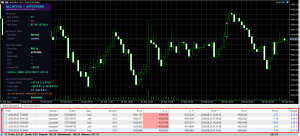
Strict Parameters on Every Order: As shown in the records every single executed trade has dedicated S / L and T / P levels logged immediately upon fill.
-
Clean Single Order Exits: Each order was opened individually managed according to risk parameters and closed out cleanly before the next trade was initiated.
Conclusion
Prop firm challenges cannot be passed with luck based systems. Grid strategies with increasing lot sizes can quickly hit the daily drawdown limit during strong market moves.