Internal vs External Structure in SMC: Pullback or Real Reversal? (With Chart Examples)
Internal vs External Structure in SMC: Pullback or Real Reversal? (With Chart Examples)
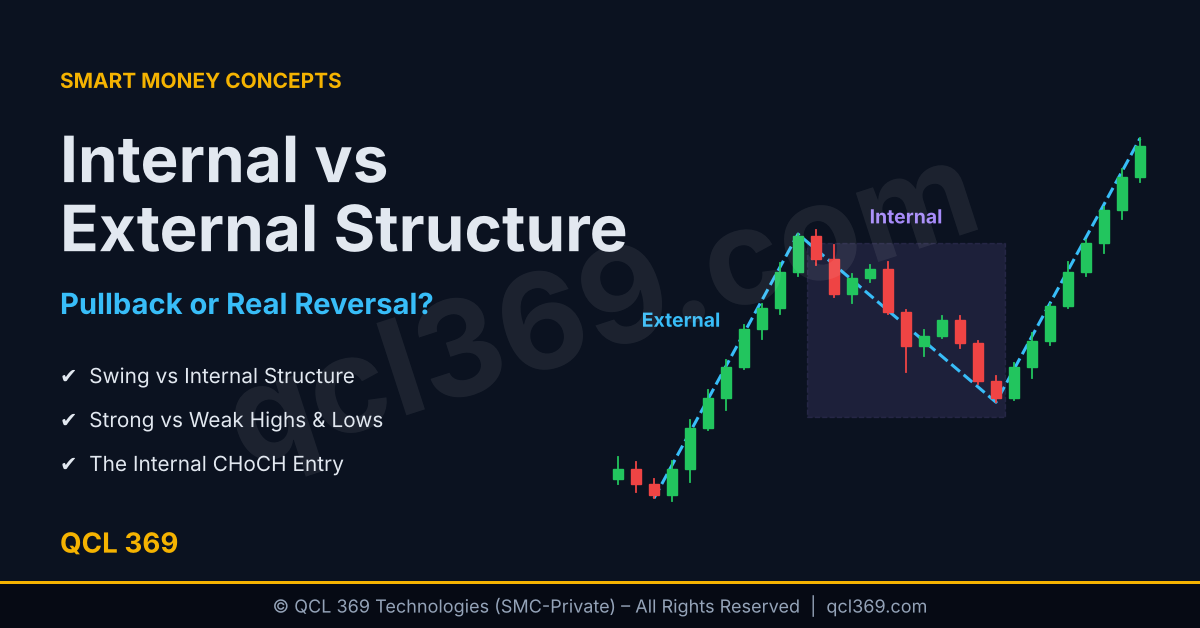
External structure is the main trend’s big highs and lows. Internal structure is the smaller swings within one trend leg, usually during a pullback. A break of internal structure shows a pullback may start or end, while a break of external structure may signal a trend change.
Mixing both is one of the biggest mistakes in Smart Money Concepts. Traders see a small CHoCH and think the trend has changed so they sell even when the uptrend is still strong. In this guide you’ll learn:
- The difference between internal and external structure
- How to spot each one on a chart
- Strong vs weak highs and lows (which levels matter)
- How to use an internal CHoCH to find a clear entry in the direction of the main trend.
- How timeframes connect the two
What Is External (Swing) Structure?
External structure, also called swing structure, consists of the main highs and lows on the chart. These are the clear turning points you can see even when you zoom out.
External structure answers one question: “What is the main trend?”
- A series of external higher highs and higher lows = bullish trend
- A series of external lower highs and lower lows = bearish trend
External swing points usually have three features:
- They are clearly visible without zooming in.
- They often take liquidity before reversing (by breaking a previous high or low).
- The move away from them broke structure (a BOS).
What Is Internal Structure?
Internal structure is the smaller highs and lows that form between two main swing points. You can see it clearly during pullbacks.
Key idea: In an uptrend, the pullback towards the next higher low is a small downward move. It has its own lower highs and lower lows. This is called internal structure.
So it’s normal and common to see:
- External trend: bullish
- Internal structure during the pullback: bearish
This doesn’t mean the trend has changed. It just means the market is taking a short break.
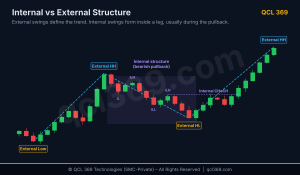
Alt text: Internal vs external market structure in SMC, showing major highs and lows with smaller swings during a pullback.
Internal vs External Structure at a Glance
| External Structure | Internal Structure | |
|---|---|---|
| What it is | Major swing highs and lows | Smaller swings inside one leg |
| Tells you | The main trend (your bias) | What the current pullback or leg is doing |
| BOS means | Trend continuation | Pullback continuing |
| CHoCH means | Possible trend reversal | Pullback may be ending |
| Used for | Bias and targets | Entry timing |
Strong vs Weak Highs and Lows
Not all swing points are equally important. SMC traders divide them into strong and weak points.
- Strong low (bullish trend): The low that pushed price up and broke structure. As long as it holds, the uptrend stays strong.
- Weak high (bullish trend): The latest high that hasn’t been broken yet. Price may move towards it because liquidity is above it.
In a downtrend it’s the opposite: the strong high is protected and the weak low is the target.
Rule of thumb: The trend stays the same until the strong point breaks. Breaking a weak point usually means liquidity is taken.
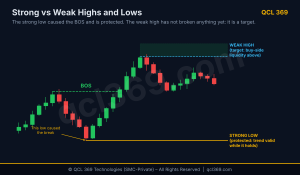
Alt text: Strong low and weak high in SMC showing the protected low and the weak high as a liquidity target.
How to Trade It: The Internal CHoCH Entry
Internal structure helps you find where a pullback ends. Wait for it to move in the same direction as the main trend.
Bullish example, step by step:
- External bias is bullish. Price is making higher highs and higher lows and just made a BOS.
- Price pulls back. During the pullback internal structure is bearish (small lower highs and lower lows).
- Wait for discount. Let the pullback reach the discount zone of the external range (below 50% see Article #3 on Premium vs Discount).
- Watch for an internal bullish CHoCH. Price closes above the last internal lower high. This tells you the pullback is probably over.
- Enter on the retest. Enter from the order block or FVG left by the move that caused the internal CHoCH.
- Stop and target. Stop below the pullback low target the external weak high and the liquidity above it.
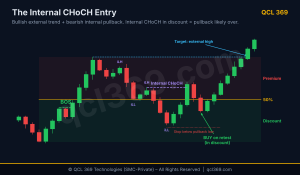
Alt text: Internal CHoCH entry in SMC showing a bearish pullback turning bullish in the discount zone of an uptrend.
You trade with the main trend and enter at a clear point with a small stop loss.
How Timeframes Connect Internal and External Structure
The same price move can be internal on one timeframe and external on another.
- What looks like a big external swing on M15 may just be internal structure on H4.
- What looks like internal noise on H4 may be a full trend on M5.
A simple way to keep it clear:
- Higher timeframe (H4/Daily): read the external structure. This is your bias.
- Lower timeframe (M15/M5): read the internal structure for entries.
When the lower timeframe moves in the same direction as the higher timeframe trend it’s called alignment.
Common Mistakes to Avoid
- Treating an internal CHoCH as a trend reversal. An internal CHoCH against the trend is usually just a pullback starting.
- Selling a pullback in a bullish trend. If external structure is bullish bearish internal structure is a buying opportunity setting up, not a reason to short.
- Ignoring the strong low or high. The external trend only changes when the strong point breaks.
- Marking every tiny swing. If you mark too many points everything looks like a CHoCH. Decide which swings are external first.
- Entering on an internal CHoCH in premium. For buys wait until the pullback reaches discount.
Frequently Asked Questions
What is the difference between internal and external structure in simple words?
External structure shows the main trend’s big highs and lows. Internal structure shows the smaller moves within that trend, usually during a pullback.
Is an internal CHoCH a reversal signal?
Only during a pullback. An internal CHoCH in the main trend’s direction may signal the pullback is ending. A trend reversal needs a break of external structure.
What is a strong low in SMC?
In an uptrend it’s the low that caused the break of structure. As long as it holds the uptrend remains valid.
Which timeframe should I use for external structure?
Most traders use H4 or Daily for the main trend and M15 or M5 for smaller moves and entries.
Conclusion
Internal and external structure help you know if the market is pulling back or changing its trend.
- External structure gives you the trend and your bias.
- Internal structure shows what the current pullback is doing.
- Strong points must break for the trend to change weak points are targets.
- An internal CHoCH in discount in line with a bullish external trend, is a precise low-risk entry.
Next time you see a CHoCH ask “Is it internal or external?” This will help you avoid selling during a normal pullback in a strong uptrend.
In the next article we’ll learn about Fair Value Gaps (FVG) how to find them and how to trade them.
Risk Disclaimer: Trading forex, indices and other leveraged products is risky and may not be suitable for everyone. This article is for learning purposes only and is not financial advice.
Related Readings
1- Market Structure in SMC: BOS vs CHoCH Explained (With Chart Examples)
2- Buy-Side vs Sell-Side Liquidity: Where Smart Money Hunts Stops (With Chart Examples)
3- Premium vs Discount Zones: How to Use Fibonacci the ICT Way (With Chart Examples)