👤 By Aqsa Ahsan
Risk Management
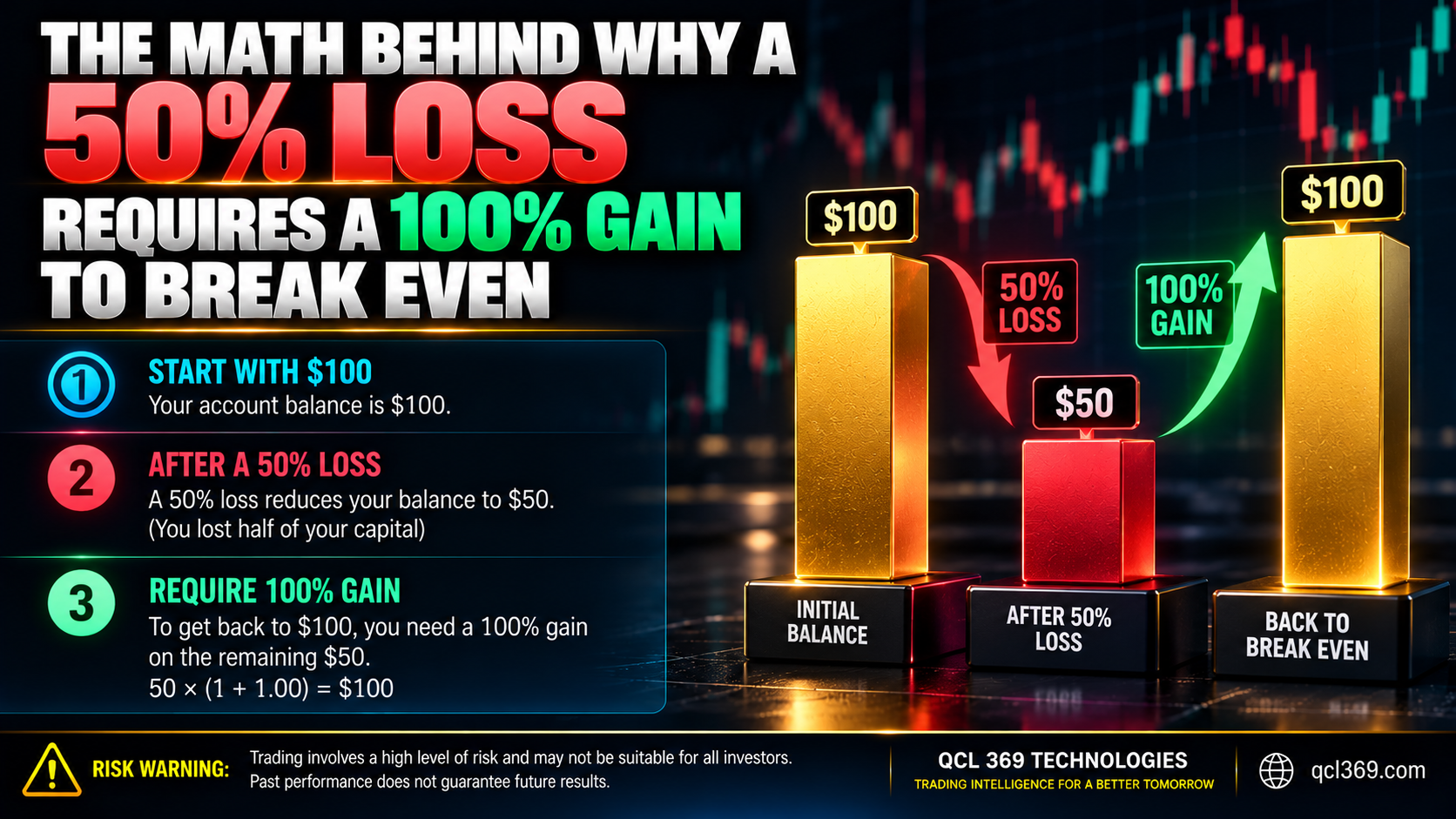
The Math Behind Why a 50% Loss Requires a 100% Gain to Break Even
The Math Behind Why a 50% Loss Requires a 100% Gain to Break Even
In financial markets losses and gains are not equal. Many beginner traders think that if a portfolio loses 20% gaining 20% will bring it back to its original value.
The math shows that this idea is wrong.
When you lose money the next percentage gain is calculated based on the smaller amount left in your account. This makes it harder to recover as your losses grow. For example a 50% loss requires a 100% gain just to get back to your starting balance.
The Mathematical Breakdown Why Percentages Lie
The main reason for this difference is that the amount left in your account changes:
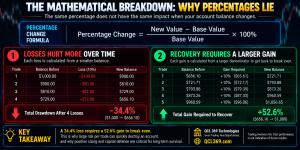
When your capital decreases your account balance becomes smaller. To recover the same amount of money you lost you need a higher percentage gain on the remaining balance.
The $10,000 Portfolio Example

To get back to your original balance your remaining money must double.
The Recovery Asymmetry Table
The deeper an account drops into drawdown the steeper the mathematical uphill climb becomes:
| Account Drawdown (%) | Remaining Capital (from $10k) | Required Return to Break Even (%) | Difficulty Factor |
| 5% | $9,500 | 5.3% | Minimal variance |
| 10% | $9,000 | 11.1% | Manageable standard recovery |
| 20% | $8,000 | 25.0% | Moderate performance pressure |
| 30% | $7,000 | 42.9% | Significant performance pressure |
| 40% | $6,000 | 66.7% | Severe structural handicap |
| 50% | $5,000 | 100.0% | Must double remaining capital |
| 60% | $4,000 | 150.0% | Extreme recovery hurdle |
| 75% | $2,500 | 300.0% | Requires quadrupling capital |
| 90% | $1,000 | 900.0% | Statistical near-ruin |
The formula governing this curve is:
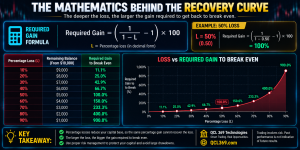
Between a 1% and 10% loss the recovery curve is almost straight. When losses go beyond 20% to 30% the curve rises much faster. At a 50% loss recovering becomes extremely difficult.
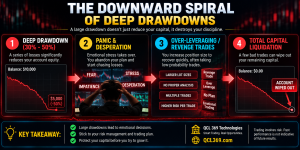
The Psychological Danger The Downward Spiral of Deep Drawdowns
Drawdowns do not just reduce your account balance they also affect how traders make decisions. When a portfolio loses 50% of its value the pressure to double the remaining money often leads to three harmful behaviors:
-
Over Leveraging to “Catch Up”: When traders realize that normal trades with a 1:2 risk to reward ratio may take months to recover their losses they stop following position sizing rules and increase their lot sizes to try to make bigger profits quickly.
-
Revenge Trading: Frustration takes over and traders stop following their trading plans. They enter trades with a lower chance of winning because they feel rushed instead of waiting for clear signs to enter.
-
Gambling on High-Risk Instruments: Traders move from carefully chosen investments to high risk markets or event based trades hoping to win big and recover their losses in one go. This often leads to losing their entire account even faster.
How to Protect Capital from the Asymmetry Trap
Because recovering from big losses is very difficult professional traders focus on limiting losses and avoiding large drops in their account balance in the first place.
1. Cap Risk at 1% Per Trade
If you risk only 1% of your total account balance per trade five losses in a row will result in a total loss of less than 5%:
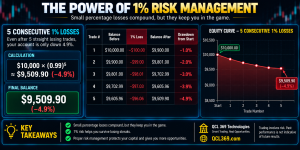
Recovering from a 4.9% loss requires only a 5.2% gain. This is possible under normal trading conditions without changing your risk limits.
2. Size Positions Dynamically
Never use the same lot size for every trade. Always calculate your lot size based on the distance between your entry price and stop loss level:
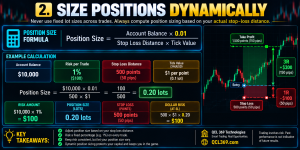
When market volatility increases the distance needed for a stop loss reduce your lot size accordingly so that the total amount you could lose never exceeds your set risk limit.
3. Establish Hard Daily and Weekly Loss Ceilings
Set mechanical circuit breakers on your account:
-
If you lose 2% of your account in a single day stop trading and close the terminal.
-
If your account loses 5% in one week stop live trading for a while review your trading journal and check whether the current market conditions suit your trading strategy.
Preventing a 10% loss from growing to 30% or 50% is one of the most important skills for long term trading success. In financial markets protecting your money always comes before making profits.
Related Readings
1- How to Be a Disciplined Trader
2- Lot Size Calculator and Risk Management Tools for MetaTrader 5 (MT5)
To get more information visit these.
1. Investopedia
Investopedia – Financial Education
2. CME Group
3. Investor.gov
Tags: bitcoin risk management break even math crypto risk management crypto trading strategy crypto trading tips drawdown trading forex money management forex psychology Forex Risk Management forex trading for beginners Gold Trading gold trading tips leverage trading liquidation risk Position Sizing profit and loss math Risk Management Trading Capital Preservation trading drawdown recovery XAUUSD Strategy