👤 By Aqsa Ahsan
Trading Psychology
Top 10 Trading Habits That Make You a Disciplined Trader
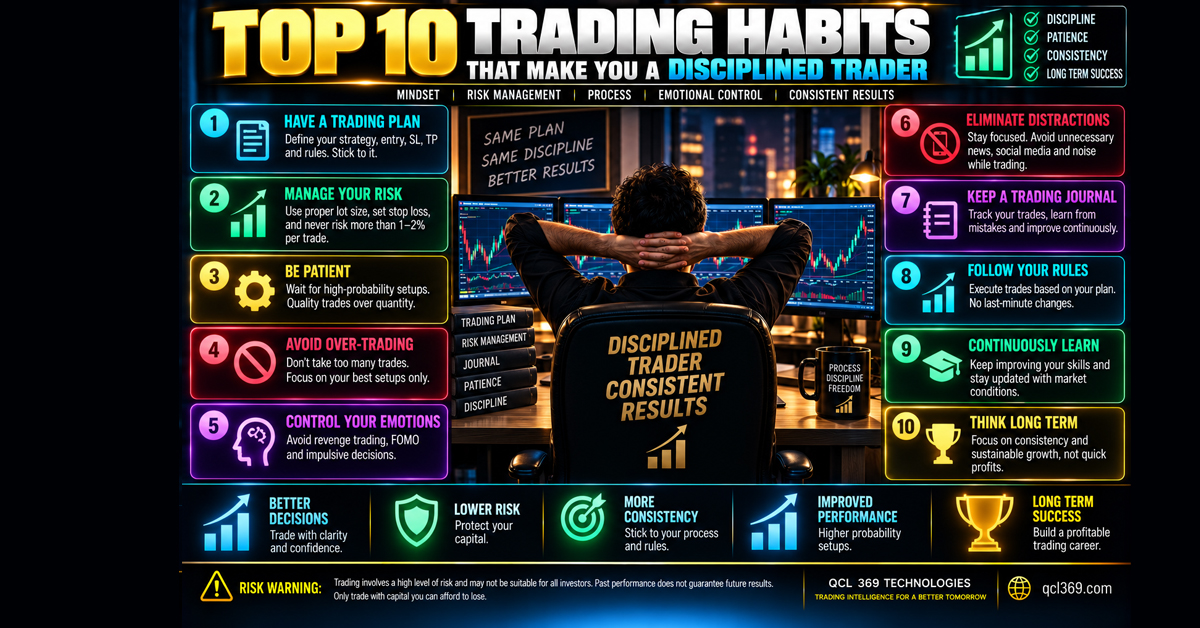
Top 10 Trading Habits That Make You a Disciplined Trader
In professional trading technical analysis and market strategies work only with proper execution. Many retail traders keep trying different indicators chart patterns and timeframes but fail to grow their accounts because they lack professional trading habits.
Trading discipline is not just a personal quality it means following daily routines and making decisions without emotions. Long term profit comes from building ten key trading habits into your daily routine.
1. Risk No More Than 1% Per Trade (Dynamic Sizing)
The best way to reduce trading stress is to keep losses small. Risking 5% to 10% per trade can lead to a 30% to 50% loss in your account during a losing streak, causing panic, denial and revenge trading.
-
The Habit: Calculate the position size for each trade based on your exact Stop Loss distance:$$\text{Lot Size} = \frac{\text{Account Balance} \times 0.01}{\text{Stop Loss Distance (Points)} \times \text{Tick Value}}$$
-
If the Stop Loss is wide use a smaller lot size. If it is tight use a larger lot size. This keeps the risk amount the same for every trade.
2. Define Entry, Invalidation and Targets Before Executing
Amateur traders enter trades based on sudden price moves and decide when to exit later. Professional traders plan every trade in advance including entry, stop Loss and Take Profit levels:
-
Entry Point: A clear price level based on a set rule.
-
Invalidation Level (Stop Loss): The price level where your trade idea is wrong. Never move the Stop Loss farther away once it is set.
-
Target Levels (TP1 / TP2): Clear price levels where you take profit instead of waiting too long for bigger gains.
3. Enforce Daily Profit Caps and Loss Limits
The brain gets tired after focusing for a long time. Without daily trading limits you may lose your morning profits in the afternoon or lose more money trying to recover earlier losses.
-
The Daily Loss Limit: If you take 1–2 losses in a row stop trading for the day. Protect your capital and come back tomorrow with a fresh mind.
-
The Daily Profit Cap: If you get 2–3 wins in a row secure your profits and stop trading. Don’t let overconfidence make you lose what you earned.
4. Wait for Candle Closes (Confirmation-at-Close)
Never enter mid candle during a price spike. Wait for the candle to close or a fake breakout can trap you and reverse against your trade.
-
The Habit: Always wait for the candle to close before entering. It helps avoid fake breakouts and confirms the price move.
5. Trade Only During High Liquidity Session Windows
Don’t trade all day. Trade only during your market’s best sessions when liquidity is high and trends are clearer.
-
Currency Pairs & Gold: Trade mainly during the London Open, New York Open and their overlap when market activity is high.
-
The Habit: Trade for 2–3 hours during high volume sessions. Follow your checklist and close your charts afterward. Avoid forcing trades during slow Asian sessions.
6. Step Aside Around High Impact News Events
Avoid trading during major news like CPI, NFP or interest rate decisions. Spreads can widen and price can move unpredictably making trades much riskier.
-
The Habit: Check the economic calendar daily. Avoid trading 30 minutes before and after major news. Wait for spreads and price action to stabilize before entering a trade.
7. Never Average Down or Use Martingale Recovery
Adding to a losing trade (averaging down) or doubling your lot size after a loss (martingale) is a dangerous mistake. It may sometimes save a bad trade in a ranging market but a strong trend can quickly use up your account’s margin and wipe out your entire account.
-
The Habit: Accept that losses are part of trading. If your Stop Loss is hit, move on. Never add more to a losing trade or open multiple trades hoping the market will turn in your favor.
8. De Risk Winning Positions with Partial Closes and Trailing Stops
Letting a trade that was up 2R or 3R turn into a full loss hurts both your account balance and your mindset.
-
The Habit: Use a two step exit plan. When price reaches TP1 close part of your trade (like 50%) to secure profits. Move your Stop Loss to breakeven or use a trailing stop for the remaining position to protect profits and catch bigger moves.
9. Maintain a Detailed Trading Journal
Traders who don’t track their results can’t improve easily. A trading journal helps you find your strengths, weaknesses and emotional mistakes.
-
The Habit: Record every single trade with:
-
Setup screenshot (before entry and after exit).
-
Time, session and market instrument.
-
Entry price, planned stop loss and target levels.
-
Execution grade (Did you follow your rules completely or did emotion interfere?).
-
- Review your trading journal every week to see which setups make you money and which habits cause unnecessary losses.
10. Cultivate Routine and Screen Detachment
Good trading needs a calm mind, controlled emotions and enough energy. Watching 1 minute charts all day causes stress and leads to impulsive trades.
-
The Habit: Build a healthy routine outside trading. Exercise get proper sleep and leave your desk when your trading session ends. Taking breaks from the market helps you stay focused calm and disciplined.
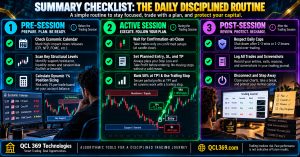
Summary Checklist The Daily Disciplined Routine
Related Reading
- How to Avoid the Bad Habits In Trading
- How to Be a Disciplined Trader
- The 1% Rule That Saves 90% of Beginner Accounts
To get more information visit these.
1. Investopedia
Investopedia – Financial Education
2. CME Group
3. Investor.gov
Tags: Crypto Trading disciplined trader emotional control trading forex discipline Forex Trading Gold Trading Strategy mt5 trading Price Action Trading profitable trader habits prop firm trading QCL AI Scalper MT5 QCL MT5 EA QCL MT5 Indicator risk management trading trading consistency trading habits trading plan trading psychology XAUUSD Trading